
Long is the day that is dawning
Land reform, raspberries, and rituals of indecency
“Free kombucha for the gypsies!”
A shout came across the sun-baked field. It was the barman, hauling in buckets of compost that had been donated to him from the surrounding food stands. Two heavy horses dragged a colourful wagon past. Their driver waved in thanks.
His mission on at the Land Skills Fair - serving ‘living drinks to restore a living soil’ - epitomised the spirit of the festival. It was three days of talks, workshops and performances, organised by Britain’s grassroots union of foresters, farmers and land workers: The Landworker’s Alliance.
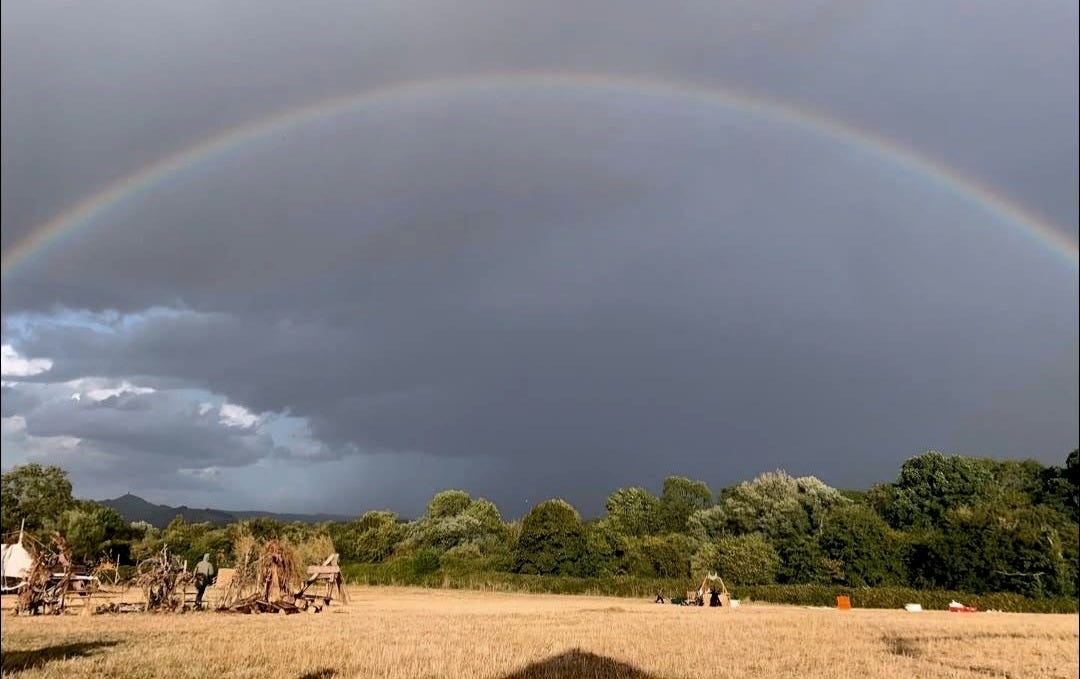
The earth at the festival site was hot and hard underfoot. Revellers who had stumbled into their tents late emerged from them early, gasping incredulously at morning’s heat. They went wincing barefoot across the spiky, yellowing grass. Wood pigeons sounded out sadly over the noise of stoves on the boil for coffees, balanced carefully by shaking hands to avoid any errant stems catching light.
Glastonbury Tor shimmered in the distance, like the vision of another possible existing just beyond our reach, on the other side of the veil.
At 11am, I walked towards a coloured tent where my impression of British history would be forever altered by a man with a kind, open face and silk waistcoat, alongside a woman who stood in a swinging dress, smiling as they waited for the crowd to quiet itself.
“The first step in resistance is a history lesson. Not one that is written for us, but one that we write ourselves.”
- Three Acres and a Cow
The duo’s comic back and forth recounted how England’s common field system of agriculture, whereby peasants could once graze stock, cut wood or peat, draw water or grow crops, on various plots of land at specified times of year, was attacked for over 1,000 years. In brief:
The Norman invasion saw the arrival of serfdom. William the Conqueror assigned land to men he saw fit to own it, and peasant farmers became tenants working the land, beholden to the will and wage provision of their landlords.
After the Black Death, serfdom gave way to customary land tenure. With the labouring population of Britain so wildly diminished by the plague, peasant farmers had much more bargaining power. Pastoral production was concentrated mainly on the large farms of landlords who were highly dependent on resident workers - which resulted in postponed marriages and curtailed childbearing - and so a ‘War on Women’ ensued. After 1350, women were increasingly confined to the domestic realm in order to go about the business of boosting the working population.
Rural oppression and the oppression of women went hand in hand for centuries. Women’s herbal wisdom - which included use of natural abortatives - was violently smothered along with our social mobility and economic participation. We were distanced from each other, our land based rituals, and the embodied knowledge of natural custodianship of our native island.
As medieval England progressed to modernity, wealthy landowners increasingly privatised the use of their land. Capitalist agriculture emerged. Landowners converted arable land over to sheep. Large-scale enclosure projects were initiated and backed by Parliament.
“The gentry are all round, stand up now.
The gentry are all round, on each side they are found, Their wisdom’s so profound to cheat us of the ground.
Stand up now, Diggers all!”
- The Digger’s Song, 1649
The peasantry responded with revolt after revolt after revolt. The terms “leveller” and “digger” appeared, referring to those who rebelled by levelling ditches and fences erected by enclosers. The participants included a high proportion of women. Pitchforks, songs, cakes and ales; revolutions erupted like carnivals of the oppressed and exploited. Authority was contested in ways that drew on traditional festive practise. Cross-dressing represented a challenge to hierarchy, and mythological figures emerged as symbolic leaders of the revolts.
In the seventeenth century, increased enclosure met increased resistance. The riots grew from local to regional uprisings and got more organised, but were brutally stamped down. The leaders of the Captain Pouch revolts of 1604-1607, for example, met violent ends at the hands of mounted vigilantes who had been hired by local landlords. This didn't stop people mobilising, though. Between 1640 and 1644 there were anti-enclosure riots in more than half of England’s counties.
And, when it came to the Civil War, Parliament couldn’t have overthrown the monarchy without the support of small producers, peasants and wage-workers. But these folk gained little from the victory, given that most MP's were substantial landowners. The new Republican government supported enclosure, sold off forests to raise revenue, and defeated the common people just as it had the crown.
Between 1750 and 1820, nearly 4,000 Enclosure Acts were passed over roughly 6.8 million acres. Despite centuries of resistance, the power of capital prevailed.
The efforts of what became the Land Reform movement did see 5 Land Acts being passed in the UK in the 1900s, to reduce the concentration of land ownership, but the story is this: the commons in England were driven out of existence, and the majority of our access to the land has been forcibly removed.
“Long is the day that is dawning - the light that is coming in the morning.”
- John Ball by Sydney Carter, 1381
I sat in that sweltering tent, surrounded by today’s landless peasants and radical hedge-priests, all incandescent with something between rage and grief and perhaps just the rising heat of the day. The songs of rebellion we’d just learnt and sung together were not yet swallowed in the back of our throats.
Taking this long view of oppression and exclusion is a heavy-lifting exercise. It's a history of defeat for women, for the working class, and for nature. The weight of this knowledge is stultifying.
But history is a contested place, and the way it is currently re-told is having an oppressive, chilling effect on the energising heat of protest. Mobilising against fossil fuel giants and breaches of human rights will land you years in prison. The 2022 and 2023 restrictions on protests and increased penalties for those involved are a tough deterrent for activists.
The truth, as brought into the light by the Three Acres and a Cow actors: people have fought long and hard to claim fair pay and workers rights, win suffrage, and regain access to the countryside. They were a threat to the establishment. They broke laws, caused outrage. Their wins were costly, but there were wins.
The play ended. We got up, stretched, and brushed ourselves down of dry grass. Within minutes, two young DJs were pumping an irresistible, energetic selection of global resistance songs across the PA system and we were all moving as a throng of sticky limbs and grins.
Amplifying and circulating stories about the rights won by rowdy gangs of disempowered folk is crucial right now. We need motivation to continue to apply pressure for justice in the face of recent expansions to police powers. We need to reclaim indecency.
“The rights that we enjoy today were not won by sober, god-fearing men acting reasonably.”
- Robin, Three Acres and A Cow
The women of the enclosure revolts had no ‘theoretical’ political power, and they still managed to conduct petitions and political campaigns on behalf of their husbands and households. They marched with banners raised and children in tow.
Despite their exclusion from political fora, women also won suffrage after decades and decades of lobbying, keeping the issue in the public eye and the mouths of MPs.
A century’s worth of ramblers skirmishing with police and landowners led to the Countryside Rights of Way Act as it stands today, and ground is still being covered. Just earlier this year, mass trespasses and media furor lead to a supreme court ruling that enshrined the right to wild camp on Dartmoor.
Even though insurrection and successful protest might feel like an object of ancestral memory and imagination, we have to resuscitate stories of unruly persistence and unlikely wins, and keep them alive.
“Ye labourers in the vineyard, We call you to your toil!
Though bleak may be the furrows, The seed is in the soil.”
- Our Summons by Ernest Jones, 1829
Keeping the pressure up is necessary because this land has been mismanaged for centuries. The UK has lost almost half of its wildlife and plant species since the Industrial Revolution, and thanks to enclosure, most of the population are too removed from this crisis to even see it. 94% of the land in the UK is privately owned, and entering upon it remains a civil offense.
Meanwhile, food sovereignty feels like a fever dream to the everyday wage labourer.
It would take a fairer food and land-use system to regenerate our natural resources whilst enabling fair livelihoods for growers. It would take employing ecologically-sound land management practices to truly nourish a population.
It would take bringing the people back.
A week or so after the festival, I was picking berries on an allotment in the city. The raspberries were tiny, heavy lanterns of scarlet pink, as perfectly shaped as the juicy glass jar jellies of an old penny-sweet store. They hung from bending tendrils in the thick, grey humidity of a summer evening.
The play I’d seen back in Glastonbury still weighed on my mind.
An allotment - one 16th of an acre - was the final outcome of the General Enclosure Act of 1845, which made provision for ‘field gardens’ to be used by the landless poor. The later ‘Small Holdings and Allotments Act’ of 1907 and 1908 imposed responsibilities on councils to provide allotments if there was a demand for them. But very little enclosed land was actually set aside for this purpose.
Today, allotments are what a lucky minority get to enjoy, having signed up to a several-year long waiting list, eventually able to tend to their plot for a yearly fee. And recent allotment rent hikes mean that the privilege of growing ones own food on common land is increasingly a middle class hobby.
I looked up from the blushing raspberry stains on my fingertips, across the patchwork of fruiting trees, lavender bushes and grapevines dangling from potting sheds. I saw cherished abundance; a place that humans devoted themselves to cultivating, which I was able to enter because someone had shared it with me.
1,000 or so years feels like a long inheritance of loss. But in the allotment I saw how, across all that time, there has been a continuity.
A slow and steady enactment of power. Not the false, short-lived expression of power gained and lost by oppressive establishments, but the eternal expression of power we see in the continuity of nature and human rituals of shared connection to it.
Every season, with varying abundance - and despite the pressures bearing down on natural cycles and systems - fruit has returned to bushes and trees. People have tended to the harvest. It has been shared. Women have continued to brew potions of raspberry leaf tea to ease their hormonal fluctuations. Preserves and jams, syrups and ciders and wines have been made. Radical folk gatherings and mass trespasses are still happening, enacting our connection to the land through footfall and song.
This is resistance, routine and ongoing. This is how we need to keep up our work - like it’s natural. Like it's a birth right. Enacting your personal liberties; the freedom of speech, the freedom to vote, to wave a banner, to walk the length of your land, to grow food or medicine... all of these things are acts of praise for your political ancestors.
Some of them sacrificed themselves so that we might embody these liberties. So we need to keep going; habitually, ceremonially, collectively. Before the amnesia of comfort kicks in - or the comfort of amnesia - and makes these conditions of disconnection seem more bearable than they really are, just because we know no other way.
The raspberries seemed to tumble headlong, eager and sweet, into the centre of my palm, even when summoned by just the softest pinch.
These precious, velvety red gems - and the space we have left to grow them in - are the legacy of all those ancestors who rushed out, singing, to meet injustice head on.
A vow to try to do the same seems like a fair exchange.
Links:
Find a performance of Three Acres and a Cow near you: Shows | Three Acres And A Cow
Support the Landworker's Alliance: Landworkers' Alliance
Support England's Right to Roam: HOME | RIGHT TO ROAM
Sources:
Leveller Women Petitioners and the Rhetoric of Power in the English Revolution (1640 - 1660) - Claire Gheeraert-Graffeuille journals.openedition.org/acs/1994
Rebel Captain Pouch - faminetales.exeter.ac.uk
Ooooft! So rich, beautiful & heartfelt. And so much to chew on. Praise the green tendrils, the pink raspberries and the people who defend their right to grow big and wild. Thank you 🌱❤️